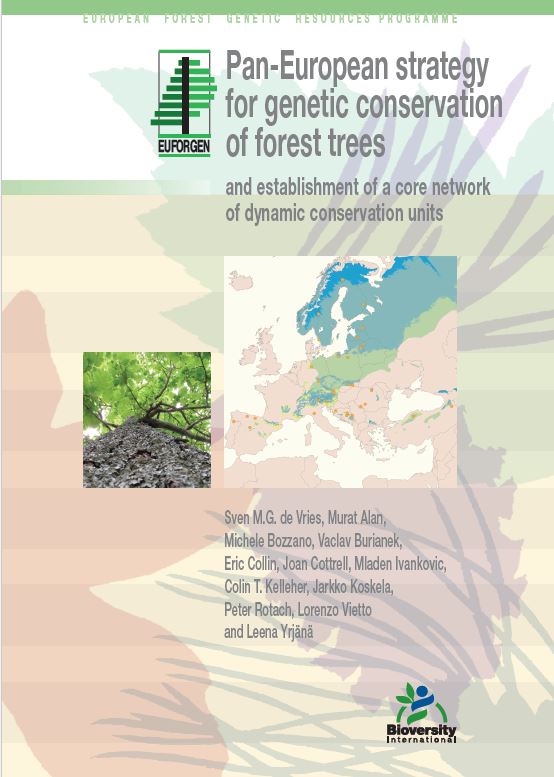
To learn more about the map elements, please download the "Pan-European strategy for genetic conservation of forest trees"
This distribution map has been developed by the European Commission Joint Research Centre (partly based on the EUFORGEN map) and released under Creative Commons Attribution 4.0 International (CC-BY 4.0)
Caudullo, Giovanni; Welk, Erik; San-Miguel-Ayanz, Jesús (2017). Chorological maps and data for the main European woody species. figshare. Collection. https://doi.org/10.6084/m9.figshare.c.2918528
The following experts have contributed to the development of the EUFORGEN distribution maps:
Fazia Krouchi (Algeria), Hasmik Ghalachyan (Armenia), Thomas Geburek (Austria), Berthold Heinze (Austria), Rudi Litschauer (Austria), Rudolf Litschauer (Austria), Michael Mengl (Austria), Ferdinand Müller (Austria), Franz Starlinger (Austria), Valida Ali-zade (Azerbaijan), Vahid Djalal Hajiyev (Azerbaijan), Karen Cox (Belgium), Bart De Cuyper (Belgium), Olivier Desteucq (Belgium), Patrick Mertens (Belgium), Jos Van Slycken (Belgium), An Vanden Broeck (Belgium), Kristine Vander Mijnsbrugge (Belgium), Dalibor Ballian (Bosnia and Herzegovina), Alexander H. Alexandrov (Bulgaria), Alexander Delkov (Bulgaria), Ivanova Denitsa Pandeva (Bulgaria), Peter Zhelev Stoyanov (Bulgaria), Joso Gracan (Croatia), Marilena Idzojtic (Croatia), Mladen Ivankovic (Croatia), Željka Ivanović (Croatia), Davorin Kajba (Croatia), Hrvoje Marjanovic (Croatia), Sanja Peric (Croatia), Andreas Christou (Cyprus), Xenophon Hadjikyriacou (Cyprus), Václav Buriánek (Czech Republic), Jan Chládek (Czech Republic), Josef Frýdl (Czech Republic), Petr Novotný (Czech Republic), Martin Slovacek (Czech Republic), Zdenek Špišek (Czech Republic), Karel Vancura (Czech Republic), Ulrik Bräuner (Denmark), Bjerne Ditlevsen (Denmark), Jon Kehlet Hansen (Denmark), Jan Svejgaard Jensen (Denmark), Kalev Jðgiste (Estonia), Tiit Maaten (Estonia), Raul Pihu (Estonia), Ülo Tamm (Estonia), Arvo Tullus (Estonia), Aivo Vares (Estonia), Teijo Nikkanen (Finland), Sanna Paanukoski (Finland), Mari Rusanen (Finland), Pekka Vakkari (Finland), Leena Yrjänä (Finland), Daniel Cambon (France), Eric Collin (France), Alexis Ducousso (France), Bruno Fady (France), François Lefèvre (France), Brigitte Musch (France), Sylvie Oddou-Muratorio (France), Luc E. Pâques (France), Julien Saudubray (France), Marc Villar (France), Vlatko Andonovski (FYR Macedonia), Dragi Pop-Stojanov (FYR Macedonia), Merab Machavariani (Georgia), Irina Tvauri (Georgia), Alexander Urushadze (Georgia), Bernd Degen (Germany), Jochen Kleinschmit (Germany), Armin König (Germany), Armin König (Germany), Volker Schneck (Germany), Richard Stephan (Germany), H. H. Kausch-Blecken Von Schmeling (Germany), Georg von Wühlisch (Germany), Iris Wagner (Germany), Heino Wolf (Germany), Paraskevi Alizoti (Greece), Filippos Aravanopoulos (Greece), Andreas Drouzas (Greece), Despina Paitaridou (Greece), Aristotelis C. Papageorgiou (Greece), Kostas Thanos (Greece), Sándor Bordács (Hungary), Csaba Mátyás (Hungary), László Nagy (Hungary), Thröstur Eysteinsson (Iceland), Adalsteinn Sigurgeirsson (Iceland), Halldór Sverrisson (Iceland), John Fennessy (Ireland), Ellen O'Connor (Ireland), Fulvio Ducci (Italy), Silvia Fineschi (Italy), Bartolomeo Schirone (Italy), Marco Cosimo Simeone (Italy), Giovanni Giuseppe Vendramin (Italy), Lorenzo Vietto (Italy), Janis Birgelis (Latvia), Virgilijus Baliuckas (Lithuania), Kestutis Cesnavicius (Lithuania), Darius Danusevicius (Lithuania), Valmantas Kundrotas (Lithuania), Alfas Pliûra (Lithuania), Darius Raudonius (Lithuania), Robert du Fays (Luxembourg), Myriam Heuertz (Luxembourg), Claude Parini (Luxembourg), Fred Trossen (Luxembourg), Frank Wolter (Luxembourg), Joseph Buhagiar (Malta), Eman Calleja (Malta), Ion Palancean (Moldova), Dragos Postolache (Moldova), Gheorghe Postolache (Moldova), Hassan Sbay (Morocco), Tor Myking (Norway), Tore Skrøppa (Norway), Anna Gugala (Poland), Jan Kowalczyk (Poland), Czeslaw Koziol (Poland), Jan Matras (Poland), Zbigniew Sobierajski (Poland), Maria Helena Almeida (Portugal), Filipe Costa e Silva (Portugal), Luís Reis (Portugal), Maria Carolina Varela (Portugal), Ioan Blada (Romania), Alexandru-Lucian Curtu (Romania), Lucian Dinca (Romania), Georgeta Mihai (Romania), Mihai Olaru (Romania), Gheorghe Parnuta (Romania), Natalia Demidova (Russian Federation), Mikhail V. Pridnya (Russian Federation), Andrey Prokazin (Russian Federation), Srdjan Bojovic (Serbia) , Vasilije Isajev (Serbia), Saša Orlovic (Serbia), Rudolf Bruchánik (Slovakia), Roman Longauer (Slovakia), Ladislav Paule (Slovakia), Gregor Bozič (Slovenia), Robert Brus (Slovenia), Katarina Celič (Slovenia), Hojka Kraigher (Slovenia), Andrej Verlič (Slovenia), Marjana Westergren (Slovenia), Ricardo Alía (Spain), Josefa Fernández-López (Spain), Luis Gil Sanchez (Spain), Pablo Gonzalez Goicoechea (Spain), Santiago C. González-Martínez (Spain), Sonia Martin Albertos (Spain), Eduardo Notivol Paino (Spain), María Arantxa Prada (Spain), Alvaro Soto de Viana (Spain), Lennart Ackzell (Sweden), Jonas Bergquist (Sweden), Sanna Black-Samuelsson (Sweden), Jonas Cedergren (Sweden), Gösta Eriksson (Sweden), Markus Bolliger (Switzerland), Felix Gugerli (Switzerland), Rolf Holderegger (Switzerland), Peter Rotach (Switzerland), Marcus Ulber (Switzerland), Sven M.G. de Vries (The Netherlands), Khouja Mohamed Larbi (Tunisia), Murat Alan (Turkey), Gaye Kandemir (Turkey), Gursel Karagöz (Turkey), Zeki Kaya (Turkey), Hasan Özer (Turkey), Hacer Semerci (Turkey), Ferit Toplu (Turkey), Mykola M. Vedmid (Ukraine), Roman T. Volosyanchuk (Ukraine), Stuart A'Hara (United Kingdom), Joan Cottrell (United Kingdom), Colin Edwards (United Kingdom), Michael Frankis (United Kingdom), Jason Hubert (United Kingdom), Karen Russell (United Kingdom), C.J.A. Samuel (United Kingdom).
Research has revealed exceptional haplotype richness even among small sample sizes, showing high intraspecific diversity (Götz et al., 2024). Within each regional cluster, genetic differentiation is low among populations from similar elevations, while northern coastal populations display greater heterozygosity than southern or interior groups. Genetic variability correlates with environmental gradients across the species’ range (Konnert and Ruetz, 1997; Götz et al., 2024).
Grand fir comprises two major geographic varieties: the coastal variety (Abies grandis var. grandis) found along the Pacific coast and the interior variety (Abies grandis var. idahoensis) found in the Rocky Mountains, each exhibiting distinct terpene synthase gene profiles linked to defence chemistry (Bohlmann and Croteau, 2007). Provenances cluster regionally, with clear genetic differentiation between Washington–British Columbia, western Oregon, and interior populations. High‑elevation populations showed the greatest genetic distance from all others, suggesting unique local adaptation or hybrid influence with white fir (Abies concolor) (Konnert and Ruetz, 1997).
Grand fir is wind pollinated and gene flow appears extensive within regions but limited between coastal and interior populations. Differences in coastal and interior habitats and fragmented mountain topography restrict pollen and seed dispersal, contributing to regional genetic structuring (Konnert and Ruetz, 1997). However, even low levels of long-distance migration can mitigate differentiation, maintaining diversity in marginal stands.
The bibliographic review was conducted by James Chaplin of the EUFORGEN Secretariat in August 2025.
Grand fir and white fir (Abies concolor) hybridize regularly and form introgression zones, especially in northern California, where hybrids exhibit elevated allelic richness compared with parent species (Ott, Strand, and Anderson, 2015; Bastien, 2016). These hybrid populations display greater phenotypic plasticity to moisture stress and high solar insolation, suggesting that interspecific gene exchange has allowed adaptive variation in challenging environments (Ott, Strand, and Anderson, 2015).
European plantations of grand fir will have used specimens imported from North America which have undergone hybridization. These hybrids are thus present in European populations, although no systematic breeding programme exists. Limited provenance trials in Germany, Poland, United Kingdom, and elsewhere indicate that seed sources from coastal Washington and Vancouver Island perform best under many European climates (Bastien, 2016). Human‐mediated selection for traits such as fast growth and climate resilience could allow for future genetic improvement.
Postglacial northward migration occurred along eastern Cascade slopes or westward from Idaho, shaping present‑day genetic gradients (Konnert and Ruetz, 1997). These historical movements, combined with local adaptation to elevation and precipitation regimes, underpin current provenance differentiation.
The bibliographic review was conducted by James Chaplin of the EUFORGEN Secretariat in August 2025.
Climate change, root pathogens, and over browsing threaten genetic integrity and regeneration of grand fir, particularly in edge and fragmented populations in the species’ home range and in Europe. Hybrid vigour in moisture-stressed areas suggests that conserving hybrid zones may buffer climate impacts (Ott, Strand, and Anderson, 2015).
Conservation efforts should prioritize high-diversity populations in the species’ home range. However, there is limited research on the species within Europe. While grand fir has seen little formal breeding, targeted selection for frost hardiness and drought tolerance, informed by provenance trials, could enhance resilience in both natural and planted forests (Bastien, 2016).
The bibliographic review was conducted by James Chaplin of the EUFORGEN Secretariat in August 2025.
Further reading
Kulej, M. and Socha, J. 2008. Effect of provenance on the volume increment of grand fir (Abies grandis Lindl.) under mountain conditions of Poland. Journal of Forest Science, 54(1): 1–8.
Xie, C.Y. and Ying, C.C. 1993. Geographic variation of grand fir (Abies grandis) in the Pacific coast region: 10-year results from a provenance trial. Canadian Journal of Forest Research, 23(6): 1065–1072. https://doi.org/10.1139/x93-136
References
Bastien, J.C. 2016. Abies grandis. In: M. Konnert and P. Alizoti, eds. Short reviews on the genetics and breeding of introduced to Europe forest tree species, pp.3–5. Studia Forestalia Slovenica, 151. Ljubljana, Slovenian Forestry Institute. https://dirros.openscience.si/Dokument.php?id=9182&lang=eng
Bohlmann, J. and Croteau, R. 2007. Diversity and variability of terpenoid defences in conifers: molecular genetics, biochemistry, and evolution of the terpene synthase gene family in grand fir (Abies grandis). In: D.J. Chadwick and J.A. Goode, eds. Novartis Foundation Symposium 223 ‐ Insect–Plant Interactions and Induced Plant Defence: Insect‐Plant Interactions and Induced Plant Defence, pp. 132–149. Chichester, UK, John Wiley & Sons, Ltd. https://doi.org/10.1002/9780470515679.ch9
Götz, J., Leinemann, L., Gailing, O., Hardtke, A., and Caré, O. 2024. Development of a highly polymorphic chloroplast SSR set in Abies grandis with transferability to other conifer species—A promising toolkit for gene flow investigations. Ecology and Evolution, 14(6): e11593. https://doi.org/10.1002/ece3.11593
Konnert, M. and Ruetz, W.F. 1997. Genetic variation among provenances of Abies grandis from the Pacific Northwest. Forest Genetics, 4(2): 77–84.
Ott, T.M., Strand, E.K., and Anderson, C.L. 2015. Niche divergence of Abies grandis–Abies concolor hybrids. Plant Ecology, 216(3): 479–490. https://doi.org/10.1007/s11258-015-0452-1
If you notice any error in the contents of this species page, please contact euforgen@efi.int
 See details
Designed by Newtvision