To learn more about the map elements, please download the "Pan-European strategy for genetic conservation of forest trees"
This distribution map has been developed by the European Commission Joint Research Centre (partly based on the EUFORGEN map) and released under Creative Commons Attribution 4.0 International (CC-BY 4.0)
Caudullo, Giovanni; Welk, Erik; San-Miguel-Ayanz, Jesús (2017). Chorological maps and data for the main European woody species. figshare. Collection. https://doi.org/10.6084/m9.figshare.c.2918528
The following experts have contributed to the development of the EUFORGEN distribution maps:
Fazia Krouchi (Algeria), Hasmik Ghalachyan (Armenia), Thomas Geburek (Austria), Berthold Heinze (Austria), Rudi Litschauer (Austria), Rudolf Litschauer (Austria), Michael Mengl (Austria), Ferdinand Müller (Austria), Franz Starlinger (Austria), Valida Ali-zade (Azerbaijan), Vahid Djalal Hajiyev (Azerbaijan), Karen Cox (Belgium), Bart De Cuyper (Belgium), Olivier Desteucq (Belgium), Patrick Mertens (Belgium), Jos Van Slycken (Belgium), An Vanden Broeck (Belgium), Kristine Vander Mijnsbrugge (Belgium), Dalibor Ballian (Bosnia and Herzegovina), Alexander H. Alexandrov (Bulgaria), Alexander Delkov (Bulgaria), Ivanova Denitsa Pandeva (Bulgaria), Peter Zhelev Stoyanov (Bulgaria), Joso Gracan (Croatia), Marilena Idzojtic (Croatia), Mladen Ivankovic (Croatia), Željka Ivanović (Croatia), Davorin Kajba (Croatia), Hrvoje Marjanovic (Croatia), Sanja Peric (Croatia), Andreas Christou (Cyprus), Xenophon Hadjikyriacou (Cyprus), Václav Buriánek (Czech Republic), Jan Chládek (Czech Republic), Josef Frýdl (Czech Republic), Petr Novotný (Czech Republic), Martin Slovacek (Czech Republic), Zdenek Špišek (Czech Republic), Karel Vancura (Czech Republic), Ulrik Bräuner (Denmark), Bjerne Ditlevsen (Denmark), Jon Kehlet Hansen (Denmark), Jan Svejgaard Jensen (Denmark), Kalev Jðgiste (Estonia), Tiit Maaten (Estonia), Raul Pihu (Estonia), Ülo Tamm (Estonia), Arvo Tullus (Estonia), Aivo Vares (Estonia), Teijo Nikkanen (Finland), Sanna Paanukoski (Finland), Mari Rusanen (Finland), Pekka Vakkari (Finland), Leena Yrjänä (Finland), Daniel Cambon (France), Eric Collin (France), Alexis Ducousso (France), Bruno Fady (France), François Lefèvre (France), Brigitte Musch (France), Sylvie Oddou-Muratorio (France), Luc E. Pâques (France), Julien Saudubray (France), Marc Villar (France), Vlatko Andonovski (FYR Macedonia), Dragi Pop-Stojanov (FYR Macedonia), Merab Machavariani (Georgia), Irina Tvauri (Georgia), Alexander Urushadze (Georgia), Bernd Degen (Germany), Jochen Kleinschmit (Germany), Armin König (Germany), Armin König (Germany), Volker Schneck (Germany), Richard Stephan (Germany), H. H. Kausch-Blecken Von Schmeling (Germany), Georg von Wühlisch (Germany), Iris Wagner (Germany), Heino Wolf (Germany), Paraskevi Alizoti (Greece), Filippos Aravanopoulos (Greece), Andreas Drouzas (Greece), Despina Paitaridou (Greece), Aristotelis C. Papageorgiou (Greece), Kostas Thanos (Greece), Sándor Bordács (Hungary), Csaba Mátyás (Hungary), László Nagy (Hungary), Thröstur Eysteinsson (Iceland), Adalsteinn Sigurgeirsson (Iceland), Halldór Sverrisson (Iceland), John Fennessy (Ireland), Ellen O'Connor (Ireland), Fulvio Ducci (Italy), Silvia Fineschi (Italy), Bartolomeo Schirone (Italy), Marco Cosimo Simeone (Italy), Giovanni Giuseppe Vendramin (Italy), Lorenzo Vietto (Italy), Janis Birgelis (Latvia), Virgilijus Baliuckas (Lithuania), Kestutis Cesnavicius (Lithuania), Darius Danusevicius (Lithuania), Valmantas Kundrotas (Lithuania), Alfas Pliûra (Lithuania), Darius Raudonius (Lithuania), Robert du Fays (Luxembourg), Myriam Heuertz (Luxembourg), Claude Parini (Luxembourg), Fred Trossen (Luxembourg), Frank Wolter (Luxembourg), Joseph Buhagiar (Malta), Eman Calleja (Malta), Ion Palancean (Moldova), Dragos Postolache (Moldova), Gheorghe Postolache (Moldova), Hassan Sbay (Morocco), Tor Myking (Norway), Tore Skrøppa (Norway), Anna Gugala (Poland), Jan Kowalczyk (Poland), Czeslaw Koziol (Poland), Jan Matras (Poland), Zbigniew Sobierajski (Poland), Maria Helena Almeida (Portugal), Filipe Costa e Silva (Portugal), Luís Reis (Portugal), Maria Carolina Varela (Portugal), Ioan Blada (Romania), Alexandru-Lucian Curtu (Romania), Lucian Dinca (Romania), Georgeta Mihai (Romania), Mihai Olaru (Romania), Gheorghe Parnuta (Romania), Natalia Demidova (Russian Federation), Mikhail V. Pridnya (Russian Federation), Andrey Prokazin (Russian Federation), Srdjan Bojovic (Serbia) , Vasilije Isajev (Serbia), Saša Orlovic (Serbia), Rudolf Bruchánik (Slovakia), Roman Longauer (Slovakia), Ladislav Paule (Slovakia), Gregor Bozič (Slovenia), Robert Brus (Slovenia), Katarina Celič (Slovenia), Hojka Kraigher (Slovenia), Andrej Verlič (Slovenia), Marjana Westergren (Slovenia), Ricardo Alía (Spain), Josefa Fernández-López (Spain), Luis Gil Sanchez (Spain), Pablo Gonzalez Goicoechea (Spain), Santiago C. González-Martínez (Spain), Sonia Martin Albertos (Spain), Eduardo Notivol Paino (Spain), María Arantxa Prada (Spain), Alvaro Soto de Viana (Spain), Lennart Ackzell (Sweden), Jonas Bergquist (Sweden), Sanna Black-Samuelsson (Sweden), Jonas Cedergren (Sweden), Gösta Eriksson (Sweden), Markus Bolliger (Switzerland), Felix Gugerli (Switzerland), Rolf Holderegger (Switzerland), Peter Rotach (Switzerland), Marcus Ulber (Switzerland), Sven M.G. de Vries (The Netherlands), Khouja Mohamed Larbi (Tunisia), Murat Alan (Turkey), Gaye Kandemir (Turkey), Gursel Karagöz (Turkey), Zeki Kaya (Turkey), Hasan Özer (Turkey), Hacer Semerci (Turkey), Ferit Toplu (Turkey), Mykola M. Vedmid (Ukraine), Roman T. Volosyanchuk (Ukraine), Stuart A'Hara (United Kingdom), Joan Cottrell (United Kingdom), Colin Edwards (United Kingdom), Michael Frankis (United Kingdom), Jason Hubert (United Kingdom), Karen Russell (United Kingdom), C.J.A. Samuel (United Kingdom).
Tree-of-Heaven shows moderate genetic diversity in the United States, even in urban environments (Aldrich et al., 2010). In its native range in China, populations exhibit high polymorphism and haplotype diversity, with genetic variation driven by intraspecific differences; this is linked to the complex environments where it occurs (Saina et al., 2023; Zhang et al., 2023). Genetic analyses consistently reveal high diversity, with slight trends towards greater variation and bottlenecks in disturbed forests. This suggests that disrupted ecosystems may produce unpredictable genetic patterns as some disturbed forests show higher genetic diversity than other such forests, a factor that may be relevant to highly disturbed European habitats (Saina et al., 2023). In Austria, recent bottlenecks in all stands indicate founder effects since introduction, highlighting how colonization history and human disturbance strongly influence the genetic diversity of invasive populations (Neophytou et al., 2020).
Genetic studies of Tree-of-Heaven are limited in both its native and introduced ranges. In its native range in China, research has found small genetic differences between populations in different environments, with three distinct genetic clusters being identified (Saina et al., 2023; Zhang et al., 2023). These studies also suggest contraction of the population range during the Last Glacial Maximum followed by expansion during the Holocene (Saina et al., 2023).
In Europe, Austrian populations appear to originate from a single source in the north-eastern native range. Vegetative reproduction has created extensive clonal structures and strong genetic differentiation not linked to spatial distance; this is due to founder effects and human-mediated seed transfer (Neophytou et al., 2020). Populations in the United States display moderate genetic variation, with small but significant differentiation and little correlation between geographic and genetic distance, a pattern consistent with multiple introductions followed by high rates of gene exchange between populations (Aldrich et al., 2010).
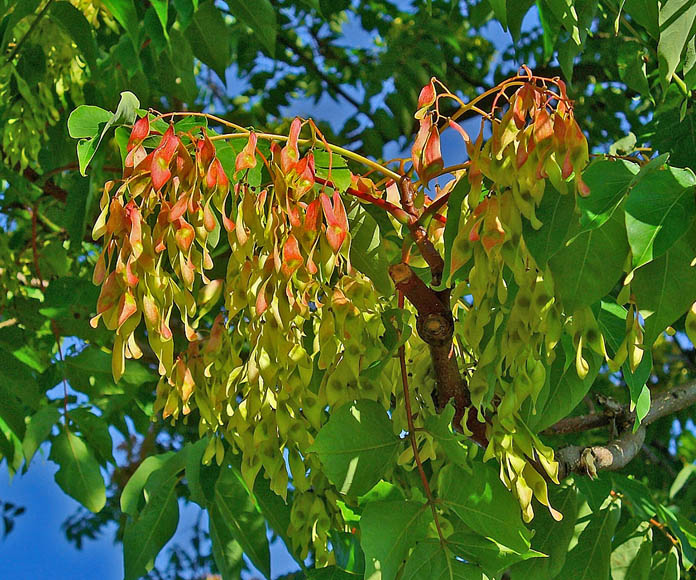
Tree-of-Heaven reproduces sexually and is dioecious, with pollen dispersed by bees and flies (Aldrich et al., 2010). Insects can move pollen over considerable distances, while seeds are primarily wind-dispersed up to 100 m, although human activity extends dispersal potential, particularly in urban and disturbed landscapes (Aldrich et al., 2010; Saina et al., 2023). A single Tree-of-Heaven can produce over 1 million seeds in a year.
The bibliographic review was conducted by James Chaplin of the EUFORGEN Secretariat in August 2025.
NA
The bibliographic review was conducted by James Chaplin of the EUFORGEN Secretariat in August 2025.
In Europe, Tree-of-Heaven is an alien invasive species and therefore faces few threats to its genetic diversity. Its ability to reproduce both sexually and clonally, combined with high seed output, ensures persistence and spread rather than loss of genetic variation.
As an invasive species, management in Europe focuses not on conserving genetic diversity but on controlling the tree’s population and limiting range expansion. Efforts are aimed at preventing further spread and mitigating ecological impacts, rather than encouraging genetic resilience.
The bibliographic review was conducted by James Chaplin of the EUFORGEN Secretariat in August 2025.
Further reading
Dallas, J.F., Leitch, M.J., and Hulme, P.E. 2005. Microsatellites for tree of heaven (Ailanthus altissima). Molecular Ecology Notes, 5(2): 340–342. https://doi.org/10.1111/j.1471-8286.2005.00920.x
Kurokochi, H., Saito, Y., and Ide, Y. 2015. Genetic structure of the introduced heaven tree (Ailanthus altissima) in Japan: evidence for two distinct origins with limited admixture. Botany, 93(3): 133–139. https://doi.org/10.1139/cjb-2014-0181
Neophytou, C., Torutaeva, E., Winter, S., Meimberg, H., Hasenauer, H., and Curto, M. 2018. Analysis of microsatellite loci in tree of heaven (Ailanthus altissima (Mill.) Swingle) using SSR-GBS. Tree Genetics & Genomes, 14(6): 82. https://doi.org/10.1007/s11295-018-1295-4
References
Aldrich, P.R., Briguglio, J.S., Kapadia, S.N., Morker, M.U., Rawal, A., Kalra, P., Huebner, C.D., and Greer, G.K. 2010. Genetic structure of the invasive tree Ailanthus altissima in eastern United States cities. Journal of Botany, 2010(1): 795735. https://doi.org/10.1155/2010/795735
Neophytou, C., Pötzelsberger, E., Curto, M., Meimberg, H., and Hasenauer, H. 2020. Population bottlenecks have shaped the genetic variation of Ailanthus altissima (Mill.) Swingle in an area of early introduction. Forestry: An International Journal of Forest Research, 93(4): 495–504. https://doi.org/10.1093/forestry/cpz019
Saina, J.K., Li, Z.Z., Ngarega, B.K., Gituru, R.W., Chen, J.M., and Liao, Y.Y. 2023. Exploring the genetic diversity and population structure of Ailanthus altissima using chloroplast and nuclear microsatellite DNA markers across its native range. Frontiers in Plant Science, 14: 1197137. https://doi.org/10.3389/fpls.2023.1197137
Zhang, M., Zheng, C., Li, J., Wang, X., Liu, C., Li, X., Xu, Z., and Du, K., 2023. Genetic diversity, population structure, and DNA fingerprinting of Ailanthus altissima var. erythrocarpa based on EST-SSR markers. Scientific Reports, 13: 19315. https://doi.org/10.1038/s41598-023-46798-2
If you notice any error in the contents of this species page, please contact euforgen@efi.int
 See details
Designed by Newtvision