Planting the OptFORESTS Mediterranean common garden in southern France
Bruno Fady and Carine Dublineau describe their adventures in planting seedlings for a provenance test in southern France's Maures Mountains.
Planting seedlings for a provenance test is easy, right? You just need to find the right place, prepare the soil appropriately, lay out your experimental design, choose the right time for planting, wait for nice seedlings to arrive and get everyone started.
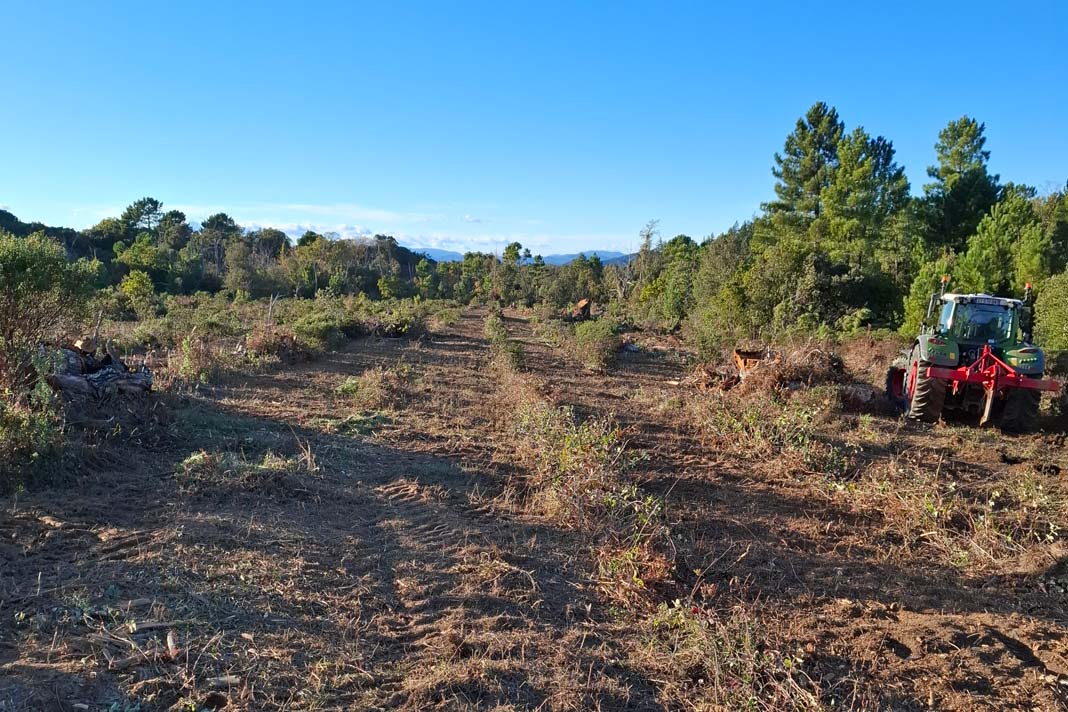
Well, not so easy for the common garden which was planted last January in the Maures mountains of southern France, just inland of the French Riviera. First, southern France is mostly calcareous, which does not work for species such as chestnut or maritime pine which cannot tolerate active calcium. Fortunately, there are two mountains between Marseille and the French-Italian border which are old acidic metamorphic areas. And after months of negotiations with all stakeholders, our team found a nice 1.2 ha plot in a state forest, a former chestnut tree grove with a few remaining ancient, barely alive and huge chestnut trees. The hardest stakeholder to convince was a reptile, Hermann’s tortoise (Testudo hermanni Gmelin), a land tortoise protected in France under Natura 2000. Removing the animals to avoid them being crushed by mechanical brush clearing and soil preparation (a 1 meter deep ripper tooth required specially trained dogs and their human partner, for sniffing tortoises out and manually removing the animals outside of the site if need be.
Once prepared in a tortoise-safe way, the plot was found to be very fertile, with deep brown soil, with only a couple of locations with unmovable bedrock where no planting could be done, making few departures necessary from the initial statistical layout prepared for all OptFORESTS provenance tests. Quite a rare situation actually in Mediterranean France where forests are found. And a good omen for our OptFORESTS common garden! The seedlings provided by the ONF Guéméné nursery arrived in excellent conditions although they had to be transferred on a parking lot on the side of a main road from the semi-trailer that moved them from Brittany to Provence to smaller vans that could take them to the rather inaccessible plantation site.
To add complication to an already complicated logistical situation, the two weeks we chose for laying out the site and distributing the seedlings to their unique location as required by the experimental design, saw records amounts of rain fall on our region. Rivers had overflown and accessing the site was a challenge that required some civil engineering from our part (mostly diverting overflowing creeks and carrying heavy rocks) to make the paths drivable for delivering the seedling crates. So much for choosing the right time for planting! We were even afraid our common garden might become one to test resistance to water excess rather than drought as planned. Fortunately, it will no doubt be dry this summer!
Fortunately, planting in the rain and cold did not deter at all the fifteen or so forestry students who came to do a practical training at manipulating planting tools and adapted protections and cautiously plant are unique reproductive material (well, there were actually some sunny spells). Two thumbs way up for our design, distribution and planting crews!
The French Mediterranean common garden of Lambert in the Maures mountains (OptFORESTS code name 25_FR1_ME) compares two oaks (Quercus petraea and Q. pubescens) and three pines (Pinus nigra, P. pinaster and P. sylvestris), each with eight provenances, and uses a few chestnut provenances as border rows. The seedlings are now in the ground, protected against rodents and small ungulates, hoping that wild boars will not find them too much to their taste. The first observations will be carried our early March 2026 and then again in the Fall of 2026 after the first growing season on site, making it possible to assess the variability of adaptive potential within and among populations and species, a new approach to common garden and provenance forest science.
An article published by Bruno Fady and Carine Dublineau, INRAE URFM, France.