Developing a methodology to improve the identification of conservation gaps in the pan-European core network of GCUs based on additional data
A EUFORGEN Task Force has prepared a concept on how to improve the way conservation gaps are detected in Europe’s network of Genetic Conservation Units (GCUs), the forest areas designated to conserve forest genetic resources. The Task Force brings together experts from France, Italy, Switzerland and the United Kingdom, with the support of the EUFORGEN Secretariat.
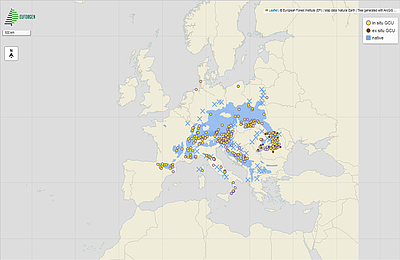
To protect the genetic diversity and adaptive potential of tree species, the GCU network needs to capture the full range of genetic diversity of each species and address any conservation gaps. This need is highlighted in the Forest Genetic Resources Strategy for Europe. Under key commitment 12, the EUFORGEN network commits to developing a methodology to improve the identification of conservation gaps in the pan-European core network of GCUs based on additional data (genetic, phenotypic, etc.).
Currently, conservation gaps are identified in EUFGIS based on environmental classification only. This provides a starting point, but it may overlook important elements such as marginal or peripheral populations, genetic structures, local adaptations and phenotypic traits. A conservation gap therefore refers not only to an absence of environmental representation, but also to insufficient conservation effort or missing knowledge about genetic and adaptive variation.
Conservation gaps are identified through a three-step process: identifying suspected gaps, validating them with the countries concerned, and assessing whether they are confirmed and require further characterisation. While gap analysis can help flag areas where conservation may be insufficient, it cannot replace the expertise of national experts and decision-makers, whose knowledge of local contexts remains essential.
Improving the identification of conservation gaps in the pan-European core network of GCUs
To respond to this commitment, a EUFORGEN Task Force has developed a concept on how to develop such a methodology. The concept proposes considering spatial, population, genetic and phenotypic diversity, as well as the diversity of local selection pressures, in an integrated way to better characterise adaptive potential.
According to the concept, a refined methodology should identify gaps in data availability as well as in network coverage. It should incorporate available information on genetic structure, gene pools and adaptive traits, and include marginal, peripheral or rare populations that may hold unique adaptive potential. It should also integrate additional environmental and ecological layers, such as soil data and refined ecological classifications, rather than relying solely on average environmental conditions, and explore the vulnerability of the network to extreme climatic events and other threats.
Two approaches are proposed: upgrading the current environmental classification with additional data, or adding a second evaluation stage in which GCUs are assessed against genetic, phenotypic and ecological criteria. Genomic tools also offer promising opportunities, although generating comprehensive genomic datasets can be complex and resource-demanding.
Expected outputs include a methodological framework building on EUFGIS, illustrative case studies on a widespread and a rare or marginal tree species, recommendations on what is possible with existing data and what would require additional data, and an outline of long-term technical objectives.