Selection as a management lever: new review on adaptation in forest trees
A recent publication in Comptes Rendus. Biologies offers a fresh perspective on forest genetic resources and sustainable forest management, with direct implications for how genetic resources are used and conserved in forest management.
A newly published review by Lefèvre (2026) invites foresters and researchers to move away from a static view of populations as simply "adapted" or "not adapted", towards a process-based approach.
Treating adaptation only as a finished state can be misleading. It risks implying that well-adapted populations have exhausted their genetic variation, and that adaptation necessarily unfolds over many generations. For long-lived organisms such as trees, which respond continuously to selection while retaining high levels of adaptive trait variation, that assumption does not hold.
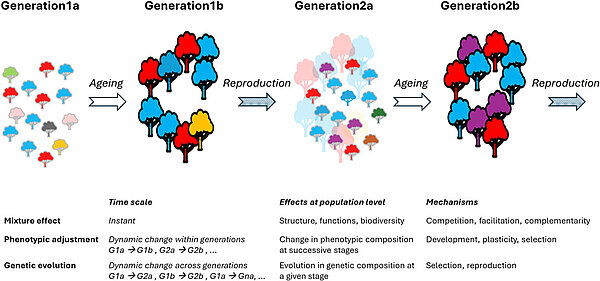
Building on the genes-traits-fitness mapping framework, the review examines how selection acts on different types of traits, how trait variation and coordination reflect both biological constraints and responses to selection, and how these relationships shift across space, time, environmental conditions, and developmental stages. A dedicated section considers how forestry interventions themselves influence trait variation and selection.
The conclusion makes the case for integrating selection into management thinking as a dynamic and, in part, manageable process. For those working on forest genetic resources, the practical message is that management decisions are already acting on selection, whether or not that is intended, and that this can be turned into a deliberate lever for conservation and sustainable use under global change.
A useful reference for anyone working at the intersection of forest genetics and sustainable forest management.
Read the full paper: Lefèvre, F. (2026). Integrating intraspecific trait variation and spatiotemporal variability of selection as levers of action in forest management. Comptes Rendus. Biologies, 349, 171-187. https://doi.org/10.5802/crbiol.200